
The launch of another school year is an apt time to take stock of new fads buzzing the educational world. The biggest one this year, by far, remains the framing of AI tools as the salvation of education. Like last year, educators, administrators and consultants are swept up in edu-tech’s hypnotic and hyperbolic AI chatter, sometimes directly crafted by industry ‘bots.
I think the AI pitch is overblown and I make no apologies for being skeptical. My curmudging attitude is forged through previous fads and experiences that I don’t perceive as different than the current AI craze. In my educator career, now almost spanning 40 years, I have endured the rise and retreat of numerous ploys that captivated the education industry, including Accelerated Learning (1990s), Learning Styles (1990s), and the Mozart Learning Effect craze (early 2000s).

These were all relatively innocuous and faded benignly into darkness. But one grandaddy ploy proved remarkably enticing and enduring: the notion of Visible Learning hatched and nurtured by New Zealand-based educational statistician Dr. John Hattie. In his 2008 best-selling text of said name, Hattie claimed to have discovered the equivalent of education’s ‘Holy Grail’: the (statistical) basis of student achievement which he ranked in a very shaky kind of factor (‘effect’) analysis.
Hattie rapidly achieved superstar status in the education world, and was wooed to keynote countless conferences, workshops, interviews and podcasts to hundreds of thousands, if not millions of doting acolytes, worldwide. Dozens of books followed and he reached celebrity status previously unknown in educational circles. Dr. Howard Gardner might trail Hattie in second place (for pioneering his Theory of Multiple Intelligences) but he’s still a long ways from the heights Hattie rose to.
From the start, various educational statisticians were skeptical and critical of his claims. He largely ignored the flack and soldiered on. In 2018, I researched his claims and wrote a paper in a PhD class voicing my (general) skepticism, which echoed a growing chorus of expert opinion. In one critical review in the McGill Journal of Education by a statistical consultant, the author wrote, “To promote (Hattie’s) work is to unfortunately fall into the promotion of pseudoscience.”
Two years ago, another longtime critic of Hattie’s, Stephen Vainker, wrote a detailed critique of Hattie’s work and claimed, with numerous precise references, Hattie was a serial plagiarist and mathematical fraud, and further, that he was being protected by academic and publishing interests that benefitted from Hattie’s celebrity. In August, Vainker wrote that his criticism of Hattie had resulted in a legal threat, but he maintains his position, with evidence presented, is sound and the legal threat baseless.
While Vainker continues to present a case for discrediting and totally ‘unmasking’ Hattie’s claims (see here), the lesson is clear: in education, as in multiple other domains of enterprise, the ‘truth’ as peddled by charismatic individuals, may turn out to be very different when subjected to intense scrutiny.
Educational myths, such as Hattie’s, can and do endure on a flawed basis. And while they may start as acorns, in the right environment (think PR) they can grow into mighty oaks.
Another myth in education that predates John Hattie by a century is a much larger one: the correlation of intelligence testing to genetic inheritance, as promoted by numerous well-credentialed psychologists such as Lewis Terman (found of ‘Stanford-Binet’ intelligence test), Henry Goddard (assigned the terms, ‘morons’, ‘imbeciles’ and ‘feeble-minded’ to children), and Robert Yerkes (devised ranking system of US military recruits based on IQ testing). This harmful myth has proven remarkably enduring over many decades, and is untangled and exposed in many texts, but none so meticulously as in ‘The Mismeasure of Man‘ by science journalist and Harvard biology professor, Stephen Jay Gould.
It requires extra diligence to scrutinize claims carried along on waves of indignant self-promotion, celebrity, and the help of complicit agents, including institutions that should do better. Intelligence testing linked to the eugenics movement, and John Hattie’s claims about educational effects, are both grandiose examples that expose flawed academic foundations. The next big one could well be AI.
In the words of the (Canadian) luminary, Marshall McLuhan: “Always question your questions, but, above all, your answers.”

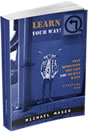 Michael’s book, Learn Your Way! SelfDesigning the Life You Really Want, Starting Now is an ERAC-approved middle and high school textbook for career planning and health education courses (British Columbia), and it has received many endorsements. Contact Michael directly to obtain a pdf copy of the book.
No comments yet.